Posts

TUTORING

For the past two years, I have been tutoring off and on for the Towns of Vernon and Coventry. I worked in the Rockville High School Special Education section from September, 2021 until  April, 2022. Shortly thereafter, I took a job private tutoring a Coventry middle school student, which evolved into a Coventry tutoring job when the school system agreed to pay for the tutoring. Rather than step aside, I agreed to stay on at a reduced pay rate to finish the work I had started with this student.  One of the parents of the Coventry student sent me a nice email thanking me for the work I had done. The email read in part as follows: "Thank you so much for what you've done for my daughter! You not only helped her survive a critical period in her life last year, but the success of your one-on-one work with her also helped me argue for more one-on-one assistance for my daughter." I enjoy working with students and helping them achieve their goals. Ken

Fraction Action

Image
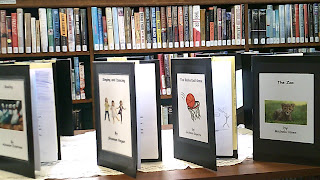
In my job as a tutor for two local school systems, I have noticed that many students struggle with fractions. There are plenty of adults that have problems with understanding fractions too. I recently read a few articles that indicated children start learning fractions around nine-years-old. I'm convinced that this issue needs to be addressed earlier in the educational learning process. I recently read how Ruth Spiro developed the Baby Loves Science series published by Charlesbridge.  On her blog, Ruth discussed how she spent about a year researching science topics to fully understand how best to explain things in very simple terms. In addition, she learned that the best way to present the science to young children was through a story with awesome illustrations of other young children. After some thought, falling back on my years of engineering and math experience, I have some solid ideas how best to approach this issue. I am in the process of developing several picture bo...

Holiday Times 2018

It's been a while since I posted on this blog. I have been very busy tutoring though, both working for the Town of Vernon and doing private tutoring work. Some weeks I've actually tutored 34 hours, which is close to being full-time. I want to wish everyone a safe and happy holiday season! This is a busy time of the year and it can be stressful too. I hope everyone gets to spend time with their families and friends! Looking forward, I hope 2019 is a good year for all of you. I'm very fortunate to be employed by the Town of Vernon at Vernon Center Middle School (VCMS).  I especially enjoy working with our students in Room 1 and with the staff. VCMS opens back up on January 3, 2019. In the meantime, my schedule is wide open for private tutoring from December 26 to January 2, 2019. If you know someone that is struggling in a particular subject, then I encourage you to contact me by leaving a comment on this blog. Thank you for reading this post and visiting my blog. ...

Is a Summer Class/Tutoring a Good Thing?

Image
As we near the end of June this year, all schools are out for the summer by now.  I'm a firm believer that students need time off from their school work/activities once summer is here. So go on vacations, take day trips to your favorite lakes or ocean beaches, go to summer camp, and generally enjoy yourself, for a while. There are some students that opt to sprinkle in some school work in the summer by taking summer classes or working with a tutor on subjects they struggled with during the school year. This is not a bad thing though. But it's important to set goals and have a tangible plan on how you will incorporate learning into your summer plans. High school students can get a jump start on their college degrees by taking certain college classes during the summer or even as part of a high school /college credit program. Many colleges have two summer sessions so perhaps the answer is to sign up for a course in the second session before returning in the fall to regular cl...

Writing Poetry, Scansion, and Rhyme

A number of years ago, I purchased a book entitled The Complete Idiot's Guide to Writing Poetry, written by Nikki Moustaki and published by Alpha Books. It has become an important reference book for me as I continue to hone my writing skills and tutor students in English and other writing classes. On page 104 of the book, Nikki includes a short course in scansion, a method that poets use to measure metrical patterns. She explains that a metrical foot is a unit of measure that measures the stresses in a line of poetry. For example, let's take the popular children's book by Dr. Seuss, Green Eggs and Ham. Two of the  lines read: "I do not like green eggs and ham. I do not like them Sam-I-am." Both last words of these two sentences rhyme, am versus Sam. Also, notice that there are 8 syllables in each sentence. When you read the two sentences out loud, they flow quite nicely. Each line is composed of 4 iamb feet. Iambic means each foot is composed of one unstressed s...

Learning the Ins and Outs of Mathematics

I have worked with many middle and high school students on math subjects. One common theme I have seen is that many students struggle with doing math calculations if the quizzes and tests rearrange how problems are structured. For example, if a student is used to calculating the slope of a straight line, m in the equation y = mx + b, they get tripped up if the problem asks for the value of b. My approach to teaching math involves helping students to thoroughly understand how to solve problems no matter what information is given to them. Also, the best way to get good at math is repetition. Each student needs to do extra work to master many concepts. Without doing this work, students freeze up in quizzes and tests and get poor results. My goal is to get students to be able to do math problems "backwards and forwards". This approach builds confidence and leads to better quiz and test results. I hope you find this post helpful. Ken Major, Tutor

Week 3-Memorizing Terms

Whether you are studying for a quiz on the chemical symbols for each element or the names of each bone in a human body, I find the best way to remember these things is to associate each item with something you have an interest or are familiar with. For instance, the symbol for tin is Sn. Now many elements use just the first letter of the element as the symbol for it, like O for oxygen or N for nitrogen. This is not the case with tin though. Many years ago I thought of a way to remember Sn was the symbol for tin. If you like golf, there's a famous golfer by the name of Sam Snead. Anyway, Mr. Snead hits golf balls into cups on the green, that is, "tin cups". That's how I remember it to this day. Try doing these associations yourself. The more personal it is to you, the more likely you'll remember the reference. It works! Ken

Week 3 - The Mole and Balancing Chemical Equations

Chemical engineers and chemists use the term "mole" for quantity measurements in their work. For example, one mole of water ( H 2 O ) weighs 18.0 grams or the sum of the gram formula weight of two hydrogens and one oxygen (2 x 1.00797 + 1 x 15.9994, rounded off to 18.0 grams). There are 6.02 x   10 23 carbon atoms in one mole of water. See the Periodic Table for the gram formula weights for each element. Then one mole of sodium chloride (NaCl) or salt has a weight of 58.5 grams ( 22.9898 grams for sodium + 35.453 grams of chloride, rounded off to 58.5 grams).                                                             Regarding chemical reactions and the equations that illustrate the process, an ...

Week 2-Straight Lines and Associated Equations

One of the primary equations associated with straight lines is the slope-intercept equation. To understand how to use this equation, one must understand the equation. The slope-intercept equation or y = mx + b, has coordinates (x,y) as points on the line, m as the slope of the line, and b, as the y coordinate (0,y) on the line that crosses the y-axis when the x = 0 (the y intercept). Slope (m) is defined as the change in y divided by the change in x. If you have an equation, y = 2x+ 3, then m=2, b=3, and two points on the line are (0,3) or (1,5). Notice that there are many solutions to this equation. For any given x value, a y value can be calculated. The slope or m is then calculated by subtracting the y values or 5-3= 2, subtracting the x values or 1- 0=1 and then dividing the y by the x or y/x = 2/1 or 2. Any equation that has these same elements can be converted into an equation to find the slope, y intercept or a point (x,y) on the line. You just need to have at least...

Week 1- Helpful Information-Using " 's " in your Writing

There's this book entitled The Elements of Style that was written by William Strunk Jr., which contains 95 pages of helpful tips to improve your writing. Mr. Strunk just happened to teach a very famous writer by the name of E. B. White, author of Charlotte's Web. I have the fourth edition of the book, which has both their names on it. Historically, E.B. White was hired to do revisions to the book. The proper use of " 's " is a topic discussed in Chapter I. Many people while writing mistakenly use "it's" for "its". The first term is actually a contraction, a shortened form of a group of words, in this case meaning "it is". The word "its" is a possessive. With nouns or pronouns, words like its, ours, mine or Steven's  indicate ownership or possession. There can be some confusion though when writers use contractions as well as nouns to show possession.  In many cases both require the use of  an " 's...

Week 1-Helpful Information-Linear Equation With Fractions

This problem requires you to solve for x. The key is to not let the fractions scare you.                                           -6(x+1) = 5(x +4)                                                5              2      Step 1: Multiply both sides of the equation by 10. The reason you do this is to eliminate the denominators on both sides. 10 is a least common denominator, that is 2 x 5 =10. This results in the following:        ...

Weekly Helpful Facts

I'm always looking for new ways to help students learn. As a result, I plan to periodically write a post that provides some helpful information about certain subjects that I tutor. One day it might be an example of a solved algebra problem. Another day I might share some common mistakes students make when writing a story. My plan is to make it an interesting and fun experience. My hope is that these posts will benefit students in their studies, become a resource for students, or at least be fun to read. I plan to start this process next week. So stay tuned to this blog and happy learning! Sincerely, Ken

Starting Major Tutoring

Hi. My name is Ken Major. Since retiring from the Connecticut Department of Energy and Environmental Protection back in 2013, I have been doing some environmental engineering work, substitute teaching in several area school systems, and tutoring students privately and for the Towns of Coventry and Vernon. I have decided to formalize my services by starting Major Tutoring. I have over 32 years of environmental engineering experience, mainly dealing with water discharge permitting and enforcement matters. My educational background, a B.S. degree in Civil Engineering from UCONN, as well as my professional experience as an engineer, has allowed me to successfully tutor a wide range of subjects, including but not limited to, math, science, social studies, and English.  I tutor students from Grades 1 through 12 and college students. My approach to tutoring centers around getting to know each student, determining what each student needs help with, building up their confidence, and try...